The Halogen War
How a cheap baking chemical, a fluoridated water supply, and a 150-year-old French formula explain what's actually wrong with the modern thyroid

The core claim: Your bread switched from iodine to bromine in the 1980s. Combined with fluoridated water and chlorinated pools, this created a sustained, low-grade multi-tissue iodine shortage that mainstream medicine still doesn't test for and doesn't address.
Why this matters beyond the thyroid: Iodine is not a thyroid mineral. Breast tissue, ovarian tissue, prostate, salivary glands, the stomach lining, skin, and brain all use it. When iodine runs short, the body prioritises the thyroid and the other tissues get whatever is left. In a modern American eating commercially baked bread and drinking fluoridated tap water, what's left is essentially nothing. You don't get one tidy iodine-deficiency diagnosis — you get fatigue, brain fog, cold extremities, dry skin that won't respond to anything, fibrocystic lumps, and slow wound healing, each of which gets managed by a different specialist who never connects the dots.
What actually happened: Potassium iodate had been in US commercial bread since the 1940s — not as a health measure, but as a baking chemistry convenience. By the 1960s-1980s, industrial automation shifted the industry to potassium bromate, which is slower-acting and gives high-speed baking lines more control. The iodine that had been quietly keeping American thyroids fed went with it. The FDA said it would review potassium bromate in 1973. In 2024 — 51 years later — that review has still not been completed. The WHO's IARC classified potassium bromate as Group 2B (possibly carcinogenic) in 1999. It was banned in the EU and UK in 1990, Canada in 1994, Brazil in 2001, China in 2005. California banned it effective 2027. Every other US state: still legal, still in your bread.
The halogen competition: Fluorine, chlorine, bromine, and iodine all have seven electrons in their outer shell — the body cannot fully distinguish between them. They compete for the sodium-iodide symporter (NIS), the transport protein that pulls halide ions into thyroid cells and other iodine-using tissues. Whatever the NIS grabs, the cell uses. When your bloodstream carries a continuous background load of bromide (from commercial bread), fluoride (from water and toothpaste), and chloride (from pools), iodine loses the competition by sheer weight of numbers. Your iodine receptors are not sitting empty waiting for you to eat seaweed — they are occupied.
The Japan correction: The commonly cited figure — that Japanese people consume 12-14 mg of iodine daily — is wrong. It traces back to a calculation error that mixed up dry and wet seaweed weight. The corrected figure from a 2011 review (Zava and Zava, Thyroid Research, PMC3204293) is approximately 1-3 mg per day. Still 8-15 times higher than average US intake (~240 mcg/day). Japanese populations have lower breast cancer mortality, lower fibrocystic disease rates, and lower thyroid cancer rates. The gap is narrowing as Japanese diets Westernise. The underlying observation — that higher iodine intake correlates with better outcomes in these tissues — remains, even though the original numbers were overstated.
The 96% figure: Dr. David Brownstein tested over 6,000 patients in his clinical practice using a urinary loading test. Approximately 96% tested deficient — many with completely normal thyroid panels. This is a single-practitioner observation in a specialty practice population, not a population-representative epidemiological study. Read it as: the kind of person who walks into an integrative practitioner's office is overwhelmingly iodine-deficient. Conventional medicine's response has not been to run better studies. It has been to continue prescribing levothyroxine — treating the hormone the thyroid fails to produce rather than the mineral shortage explaining why it's failing.
The Lugol's asymmetry: Lugol's solution — a 200-year-old French formula combining elemental iodine and potassium iodide — requires DEA paperwork to purchase above 2.2% concentration because iodine was used in methamphetamine production. Bromated bread that displaces iodine from your thyroid sits unregulated next to the lettuce. The formula provides both iodide (preferred by thyroid tissue) and molecular iodine (preferred by breast, ovarian, and other iodine-using tissue). A 1993 randomised trial by Ghent and Eskin found molecular iodine significantly more effective than iodide alone for fibrocystic breast disease — which is why the dual-form delivery matters.
The Wolff-Chaikoff caveat: If you ask an endocrinologist about iodine supplementation above the RDA, they will mention the Wolff-Chaikoff effect — a 1948 finding in rats that high-dose iodide suppressed thyroid hormone production. This has been used for 75 years to justify the position that supplemental iodine above goiter-prevention levels is dangerous. The original study used rats, intraperitoneal injection (not oral), and doses that don't scale cleanly to common human supplemental ranges. The rat study has not been replicated in humans at the oral doses used by practitioners in the iodine literature.
What to do this week: Switch bread to bromate-free (King Arthur, European brands, many artisan bakeries — or Izzio from Walmart, which is organic, genuine sourdough, and around $5). Filter fluoride from drinking water. Switch out fluoridated toothpaste. Shower after chlorinated pools. If you're considering iodine supplementation, start low, include the cofactors (selenium, unrefined salt), and if you are on thyroid medication, don't start an iodine protocol without working with a practitioner — the interaction is real and needs supervision.
For most of the 20th century, commercial bread in the United States was conditioned with potassium iodate. It wasn't a public health initiative or a conscious nutritional policy, but a baking chemistry decision, a side effect of how dough was made to rise faster and more consistently. But that incidental iodine, delivered in unremarkable daily slices to virtually every American, was quietly keeping thyroids fed and breast tissue doing what breast tissue is supposed to do. Just enough, daily, to keep the thyroid fed and breast tissue from turning into a lumpy complaint the doctor calls "benign" and declines to investigates further.
Then the baking industry switched.
Potassium iodate - out. Potassium bromate - in.
Not because bromate was safer or because iodine had been causing problems. The real timeline is less dramatic and more damning than the version that circulates online. Potassium bromate had been permitted in flour since 1941 and in bread since 1952, and by the time the 1958 Food Additives Amendment passed, it got grandfathered in as Generally Recognized As Safe - a classification that functionally means "we already let them use it and formally establishing whether it's actually safe is somebody else's problem now." [^1]
Over the 1960s and 70s, as commercial baking industrialized at scale, bromate became the preferred oxidizing agent because it behaves differently in the dough than iodate does. Iodate is fast-acting, burning off during mixing. Bromate is slow - it's still working during proofing and the early stages of baking, which gave high-speed industrial operations more control over the full production timeline. By the 1980s the switch was effectively complete[^2], and the incidental iodine that had been quietly running through the bread supply for decades went with it.
In 1973, the FDA announced a planned literature review of potassium bromate. As of the actual literal calendar year you are reading this in, that review has never been formally completed. The FDA opened a renewed review in 2024 - 51 years after the original promise. [^3] [^4]
A literature review.
Of a chemical they have been allowing in your sandwich bread for over eight decades.
The World Health Organization's International Agency for Research on Cancer (IARC) classified potassium bromate as Group 2B - possibly carcinogenic to humans - in 1999. [^5] That was 27 years ago. Potassium bromate has been banned in the EU and the UK since 1990, Canada since 1994, Brazil since 2001, China since 2005. [^6] California finally banned it in October 2023 with the California Food Safety Act (AB 418), with the ban taking effect January 1, 2027. [^7]
In every other US state, as of this article going out, it is still legal. It is still in commercial bread. It is still on toast in school cafeterias and behind the deli counter of the supermarket where you bought your "wholegrain" sliced loaf this week.
The FDA has known the IARC classification for over a quarter of a century.
Nothing has changed federally.
Welcome to the Halogen War.
The iodine deficiency in modern America is not in dispute among practitioners who actually work with iodine. It is a documented multi-tissue shortage created by bromate-laced bread, fluoridated water, and chlorinated swimming pools, and the conventional RDA of 150 mcg per day has never been seriously updated to account for any of those exposures. What follows is how the bread switched, what the science actually shows about halogen competition in the body, and what to do about it before the next "wholegrain" sandwich.
What you'll find in this article:
- Why potassium bromate is in your bread - and why the FDA has been "reviewing" it for 51 years without finishing
- The exact biological mechanism by which bromine, fluorine, and chlorine displace iodine from your thyroid receptors
- Why the famous "Japanese consume 12-14 mg of iodine daily" claim is wrong - and what the actual number is
- The 96% deficiency rate Dr. Brownstein found in 6,000 patients tested for iodine status - and why mainstream medicine has ignored it for 25 years
- The 200-year-old French formula (Lugol's solution) that the DEA briefly classified as a meth precursor
What a halogen actually is, and why your body keeps confusing them
This section gets a little chemistry-shaped. Stay with me, because the entire rest of the iodine conversation depends on it.
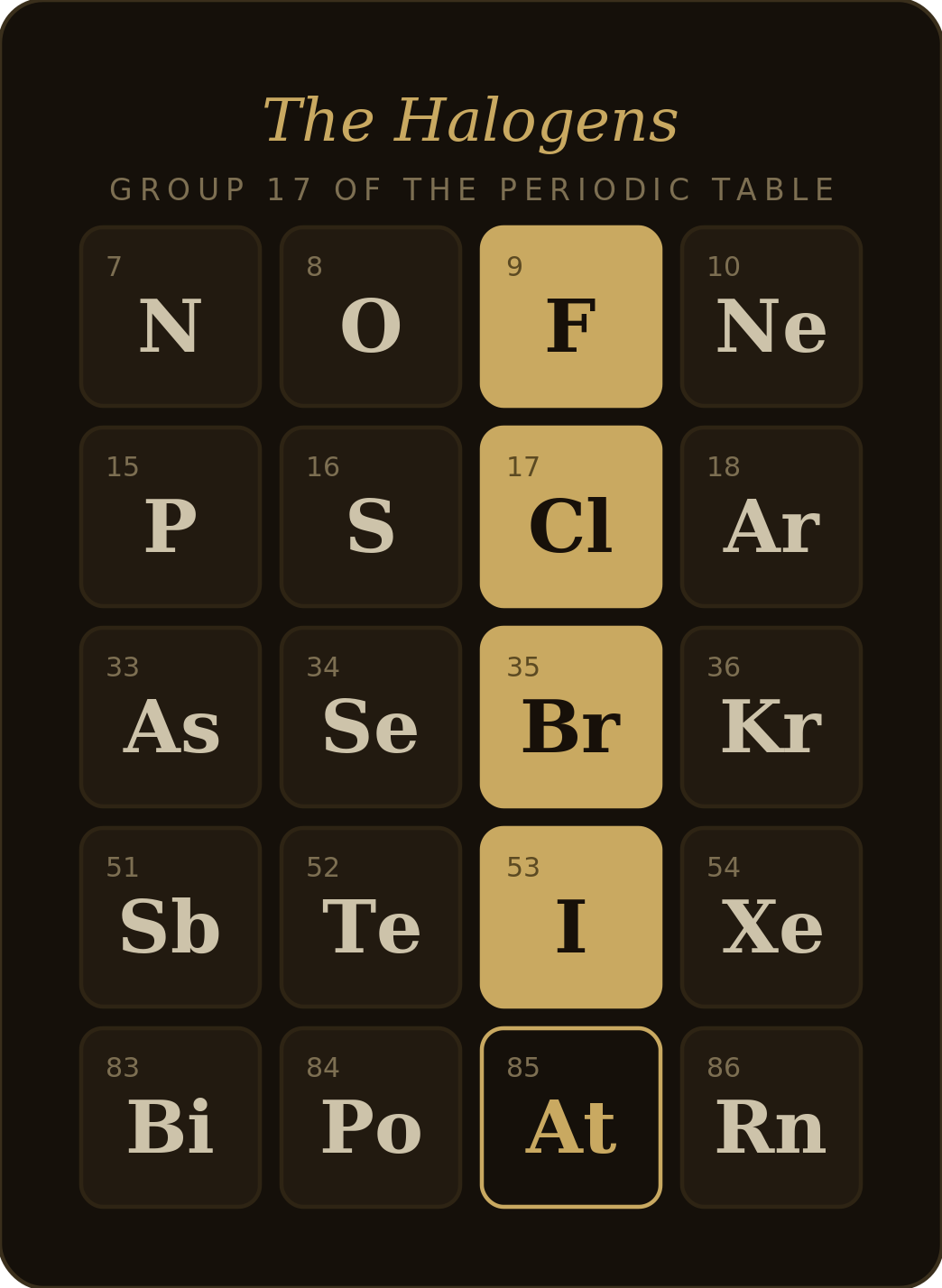
The halogens are a family of elements on the periodic table that includes - in order from smallest to largest atomic radius - fluorine, chlorine, bromine, and iodine. Astatine and tennessine round out the group but you don't encounter them in real life unless you work in a particle accelerator, so I'm ignoring them here.
These four halogens share a key trait: they all have seven electrons in their outer shell, which makes them aggressive about grabbing an eighth to complete the set. That shared electron configuration means they behave similarly in the body. They get absorbed through similar mechanisms. They bind to some of the same receptors. They are, biologically, in competition with each other.
The receptor that matters most for this conversation is the sodium-iodide symporter, or NIS. The NIS is a transport protein that sits on the membrane of certain cell types - most famously thyroid cells - and shuttles iodide ions from the bloodstream into the cell where they can be used to build hormones. Whatever the NIS pulls in, the cell uses.
Here's the catch.
The NIS is not a fussy bouncer. It will let in any halide ion it recognises, and it recognises all four halogens to varying degrees. In experimental settings, the relative affinity of the NIS for the major halides runs roughly: perchlorate > iodide > bromide > chloride > fluoride. Iodine has decent affinity but is not the strongest binder in the group. 8
What that means in practical terms: if your bloodstream is full of bromide because you ate three slices of commercial bread, the NIS will pull bromide into the cell. If your water is fluoridated, fluoride competes for thyroid uptake at high enough exposures. If you swim regularly in a chlorinated pool, chloride exposure goes up. If you live in a normal modern American environment, you are absorbing a low-grade, continuous load of three halogens that compete with iodine for the same biological real estate.
This is what biochemists mean when they say "competitive inhibition." Two molecules competing for the same binding site. The one present in greater concentration, or with the relevant receptor affinity at the conditions of that moment, wins.
When iodine is scarce - as it has been in the standard American living since the fluoridation of water and toothpaste and the bromination of bread and pools, the competing halogens win by sheer weight of numbers.
Your iodine receptors are not sitting empty waiting for you to start eating seaweed.
They are occupied. By squatters. With no intention of leaving on a few micrograms.
The Japan question (with the math actually done properly)
If you spend any time in iodine-aware circles, you will eventually hear the claim that the Japanese consume 12 to 14 milligrams of iodine per day from dietary seaweed. This figure has been cited by Dr. Brownstein, Dr. Abraham, Lynne Farrow, and a thousand iodine bloggers including, until I checked again, me.
It is wrong.
The 12-14 mg figure traces back to a calculation that mixed up dry seaweed weight and wet seaweed weight, multiplied through to an intake estimate, and produced a number that was about ten times too high. It is the iodine equivalent of confusing dehydrated stock cubes with chicken broth. The error has been repeated for decades because nobody wanted to dig back into the source paper.
In 2011, Zava and Zava published a careful review in Thyroid Research that pulled together the actual primary data on Japanese iodine consumption from urinary excretion studies, food frequency surveys, and dietary records. Their conclusion: the average Japanese intake of iodine sits in the range of approximately 1,000 to 3,000 micrograms per day. So roughly 1 to 3 milligrams. 9
That is still substantially higher than the United States. Average US adult iodine intake is said to be around 240 mcg/day. 10 and the NIH gives Total Diet Study estimates around 216 mcg/day for iodine from foods...BUT that number is based on ideal storage and preparation of iodised foods and accounts little for any loss during cooking.
So the Japanese intake is still about eight to fifteen times the American intake. But there's no way to justify the claim that it's eighty times higher.
I'm flagging the corrected number because my readers are intelligent and a few of you will fact-check this. Better to put a more accurate version on the page than have a doctor or nutritionist email me three months from now telling me the iodine community is built on bad arithmetic. There is still some truth to that, but the underlying observation - that Japanese populations consume more iodine and have correspondingly better outcomes in certain thyroid and breast tissue conditions - is still robust. 11
Whatever the precise multiplier, the relevant population-level data still shows that Japan has historically had substantially lower breast cancer mortality, lower fibrocystic breast disease, and lower thyroid cancer rates than the United States, and the gap has been narrowing exactly as Japanese diets have Westernised. 11 12
The conventional iodine RDA in the United States is 150 mcg per day. That number was set in the 1920s to prevent goiter - the visible swelling of the thyroid that was endemic in the iodine-poor Great Lakes region and inland Midwest. It has never been seriously updated to account for halide competition, soil depletion, the rise of non-iodised specialty salts, fluoridation of water, or the tissue needs of any organ other than the thyroid gland itself.
The current Japanese intake is, conservatively, several times the US RDA.
A reasonable hypothesis: the US RDA is calculated to prevent the most visible deficiency outcome in the absence of halide competition, and accounts for almost none of the conditions modern Americans actually live in.
I have not yet seen this hypothesis seriously addressed in a federal nutritional guideline.
The Iodine Project, the doctors who built it, and the orthodoxy that buried them
Dr. Guy Abraham was a former UCLA OB/GYN professor who, after a long academic career, founded Optimox Corporation in 1978. In 1997 he launched what he called The Iodine Project - a multi-year research and clinical-protocol effort to investigate iodine deficiency in modern American populations. Abraham's framework, drawing on a literature he traced back through the 19th century, was that whole-body iodine sufficiency required orders of magnitude more iodine than the goiter-prevention RDA. He developed Iodoral - a tablet form of Lugol's solution containing 12.5 mg of iodine/iodide - as a practical delivery method. 13
Dr. David Brownstein, a Michigan internist, took up Abraham's protocol in his clinical practice in the late 1990s and 2000s and tested over six thousand patients for iodine status using urinary loading tests. His clinical observation: approximately 96% of those patients tested deficient, many of them with normal thyroid panels. 14
Now, the standard caveat: this is a single-practitioner observation in a specialty practice. It is not a population-representative epidemiological study. The 96% figure should be read as "the kind of patient who walks into Brownstein's office is overwhelmingly iodine-deficient" rather than "96% of all Americans." It is data. It is not gold-standard data. I'm flagging this so you read it with appropriate framing.
But I am also flagging this: nobody else has done the loading test on six thousand patients and published better contradictory data. The 96% is the number we have. The conventional thyroid community's response has not been to do better research. It has been to ignore the question entirely and continue prescribing levothyroxine.
Speaking of which...
Levothyroxine - synthetic T4 - has been one of the top three most-prescribed drugs in the United States by total prescription count for over a decade. 15 It was the number one prescription for several of those years. Millions of Americans take it daily. Most of them will take it for life, because once the thyroid has shut down hormone production in response to having the upstream signalling chronically blunted, it does not generally spin back up without some serious effort.
Treating an iodine deficiency by replacing the hormone the thyroid is failing to make is purely treating a symptom. It is not addressing the underlying mineral shortage. It is also extraordinarily profitable.
Dr. Abraham, in several of his writings, was direct about this dynamic. He referred to what he called "medical iodophobia" - the institutional fear of iodine that seeded itself in mid-20th-century medicine after the 1948 publication of the Wolff-Chaikoff effect. 16
Sidebar: the Wolff-Chaikoff effect, and the rat study that built a wall
In 1948, two researchers at UC Berkeley - Jan Wolff and Israel Chaikoff - published a study on rats given intraperitoneal injections of iodide at very high doses. They observed a temporary suppression of thyroid hormone production in those rats. This finding was extrapolated, over the following decades, into the broad clinical assumption that iodine doses above the standard RDA were dangerous.
The catch: that extrapolation has never been formally replicated in humans at the dose ranges (12.5 mg to 50 mg orally) that the Iodine Project uses. The original study used rats, intraperitoneal injection (not oral), and doses that scaled to human-equivalent levels far above what most supplementing patients actually take. 17
The thyroid endocrinology field has, broadly, treated Wolff-Chaikoff as load-bearing infrastructure for the position that supplementing iodine above the goiter-prevention dose is reckless. The Iodine Project doctors treat it as a methodologically flawed rat study that ossified into orthodoxy because it was useful to a particular therapeutic model.
Both positions exist in the literature. This article is not the place to settle them. But if you are looking at the dose ranges Brownstein and Abraham used and wondering "isn't that toxic?", the answer your endocrinologist will give you is rooted in a 78-year-old rat study that has not been redone.
Where iodine actually goes in the body (and what happens when it isn't there)
The thyroid is the most famous iodine-using organ but it is not the only one. Tissues throughout the body express the sodium-iodide symporter and require iodine to function normally. Breast tissue. Ovarian tissue. Prostate tissue. Salivary glands. The stomach lining. Skin. Brain. 8
When iodine is in short supply, the body prioritises the thyroid. The other tissues get whatever is left over. In a modern American with low dietary iodine, three competing halogens loading the system, and no supplemental intake, what's left over is essentially nothing.
This is why iodine deficiency does not present as one tidy syndrome that an endocrinologist can diagnose. It presents as a constellation of complaints across multiple organ systems. Fatigue. Brain fog. Cold extremities. Dry skin that doesn't respond to anything. Fibrocystic breast tissue. Ovarian cysts. Slow wound healing. Hair thinning. Cognitive dulling that gets written off as stress.
Each of those gets evaluated, in conventional practice, in its own siloed specialty. The dermatologist looks at the skin. The breast surgeon looks at the lumps, the GP looks at the TSH and tells you it's normal - but who connects the dots when nobody is paid to connect the dots?
We will go through this in detail in articles 2 and 3 of this series. For this one, just hold the framework: iodine is not a thyroid mineral. It is a multi-tissue mineral. The thyroid is just the first organ to scream when it runs out.
Lugol's solution - the 200-year-old formula that the DEA briefly classified as meth precursor
In 1829, a French physician named Jean Lugol formulated a solution of elemental iodine and potassium iodide in water as a treatment for scrofula - tuberculous cervical lymphadenitis, considered at the time to be an early form of tuberculosis. 18 The TB application didn't pan out. The formula did pan out for just about everything else.
The dual-form delivery is very important.
Thyroid tissue preferentially uses iodide (I-) - the reduced, anionic form. Breast, prostate, ovarian, and certain other tissues preferentially absorb molecular iodine (I2) - the elemental form. The two forms are not interchangeable at the tissue level. A 1993 randomised study published in the Canadian Journal of Surgery on women with fibrocystic breast disease, led by William Ghent and Bernard Eskin, found that molecular iodine was significantly more effective than iodide alone at reducing fibrocystic symptoms. 19
Lugol's solution provides both. That is not overengineering. That is the entire design point.
The formula has not changed in nearly 200 years because it does not need to.
In 2007, the DEA reclassified iodine. Iodine crystals and high-concentration iodine solutions had been used in clandestine methamphetamine production. The DEA's response was to move iodine from List II to List I chemicals under 21 CFR Part 1310 - which meant sales of iodine solutions above 2.2% concentration now triggered record-keeping requirements identifying buyer name and address. 20 This is the rule that's still on the books. It's why purchasing higher-strength Lugol's (5% or 7%) from a US supplier involves paperwork that purchasing chlorine bleach does not. The DEA needed to track meth precursors. The unintended consequence is that the strongest version of a 200-year-old French medical preparation is now functionally regulated like a controlled substance, while the bromated bread that displaces iodine from your thyroid sits unregulated next to the lettuce.
(I have thoughts about this regulatory asymmetry. I will save most of them for the email version of this article. For what it's worth: this publication exists to educate, not to sell you anything. If you want sourcing recommendations, article 6 covers that too.)
What this means in your kitchen this week
The series this article opens will unpack each piece of the iodine puzzle in turn. Article 2 looks at the symptoms that are often misread, mislabeled, or chased in circles when iodine status is never properly considered. Article 3 is about the breast tissue story specifically. Article 4 is the iodised salt situation in detail. Article 5 is what iodine does as an antimicrobial that no antibiotic can match. Article 6 is the cofactor protocol - what you take alongside iodine to make it work without making yourself feel rough.
For this article, the takeaway is simpler than any of the protocols that come next.
The modern American food and water supply is bromine-, fluorine-, and chlorine-rich and iodine-poor. That combination is the source of a chronic, low-grade, multi-tissue deficiency that mainstream medicine does not test for and does not treat. It has been this way for fifty years. The institutions responsible for the food supply have known about the displacing halogens for at least twenty-five years. They have not acted and it does not appear they are going to act.
Your health is your responsibility.
It's simple to be healthy, but it takes time and effort, which means priorities may have to shift. What you can do, this week: switch your bread to a loaf that lists no potassium bromate in the ingredient panel (any "King Arthur" or European-style brand is bromate-free; many small artisan bakeries are too). I've actually found a pretty fantastic source of bread at Walmart, of all places! It's called Izzio and it has all organic ingredients, no refined sugar, genuine sourdough...and it's only $5! Win!
Get a water filter that removes fluoride if you're on a fluoridated municipal supply and switch out that fluoridated tooth paste. Blegh. Here's another option if you want to consider tooth powder instead.
If you swim regularly in chlorinated pools, shower as soon as you get out and consider supplementing iodine to compete for receptor occupancy.
That is the floor. Everything in the rest of this series is what you can do above the floor.
If you want to skip ahead and start now: many practitioners who work with iodine begin with a low daily dose of Lugol's solution alongside selenium and adequate unrefined salt. Article 6 covers the full cofactor protocol - including what to take, in what order, and why the cofactors matter as much as the iodine itself. If you are on thyroid medication, do not start any iodine protocol without working with a practitioner who actually understands iodine.
Outliers and what they're saying
A few positions in this article fall outside mainstream consensus. I'm marking them so you can read with appropriate framing.
Outlier position 1: That the conventional iodine RDA of 150 mcg/day is dramatically inadequate for a population also exposed to bromide, fluoride, and chloride at modern levels.
Mainstream position: the RDA is sufficient for thyroid function in the general population.
Outlier evidence: Brownstein's 96% deficiency observation in 6,000 patients tested by urinary loading; Abraham's Iodine Project clinical observations; the Japan comparison data.
Outlier position 2: That the Wolff-Chaikoff effect is methodologically inadequate to justify the broad clinical fear of supraphysiological iodine doses.
Mainstream position: high-dose iodine carries thyroid suppression risk and should be avoided in most patients.
Outlier position: the original 1948 study was on rats with intraperitoneal injection and has not been replicated in humans at the oral doses being used clinically by iodine-aware practitioners.
Caveat: there is some evidence of transient thyroid effects in humans at very high acute doses, but the dose-response curve in chronic oral supplementation is not what Wolff-Chaikoff was actually measuring.
Outlier position 3: That medical iodophobia is, partially, downstream of pharmaceutical economics. This is Abraham's framing. It is not provable. It is also not a crazy framing given the relative economic value of a generic mineral supplement versus a daily-for-life hormone replacement.
I am not telling you these positions are correct. I am telling you they exist, they have data behind them, and they are not being addressed adequately by the mainstream institutions that should be addressing them. You are an adult. You can read the underlying sources I have linked and form your own view.
~ Emily
What's next
Article 2 in this series: Your Thyroid Is Starving (And Nobody Checked the Obvious) - the symptom list that gets misdiagnosed six different ways before iodine is ever considered, why TSH does not tell you what you think it tells you, and what the iodine loading test actually measures.
Educational purposes only. Not medical advice. Not intended to diagnose, treat, cure, or prevent any disease. If you are on thyroid medication or have a diagnosed thyroid condition, find a practitioner who actually understands iodine physiology before you start supplementing. The protocols described here are observational and reflect Emily's own reading of the iodine clinical literature, not a prescription.
References and further reading
Additional reading: - Farrow L. The Iodine Crisis: What You Don't Know About Iodine Can Wreck Your Life. Devon Press, 2013. The patient-side account of years of misdiagnosed iodine deficiency. - Grønseth T et al. "Lugol's solution eradicates MRSA biofilm in skin wound infections." International Wound Journal 20(1):120-130, 2023. https://onlinelibrary.wiley.com/doi/10.1111/iwj.13846
Enjoyed this? Queen of Herbs publishes research-grade herbal medicine writing weekly.
Read more at Queen of Herbs →- Potassium bromate regulatory history in the US: permitted as flour additive at 50 ppm in 1941, bread additive at 75 ppm in 1952, grandfathered under the 1958 Food Additives Amendment as GRAS. See Wikipedia's overview of potassium bromate regulatory history for the primary references: https://en.wikipedia.org/wiki/Potassium_bromate ↩
- Industrial transition from potassium iodate to potassium bromate as the dominant US dough conditioner occurred broadly between the 1960s and 1980s, accompanying the rise of high-speed automated commercial bakery operations. See: https://en.wikipedia.org/wiki/Dough_conditioner ↩
- US Right to Know summary of the FDA's 1973 announcement and subsequent inaction on potassium bromate: https://usrtk.org/chemicals/potassium-bromate/ ↩
- The FDA's renewed review of potassium bromate opened in 2024, 51 years after the original 1973 announcement. ↩
- International Agency for Research on Cancer Monograph Vol. 73 (1999) classifies potassium bromate as Group 2B - possibly carcinogenic to humans: https://inchem.org/documents/iarc/vol73/73-17.html ↩
- Country-by-country potassium bromate bans: EU and UK 1990, Canada 1994, Brazil 2001 (ANVISA Resolution RDC No. 90), China 2005. Reference summary at Additive Checker: https://www.additivechecker.com/additive/e924/ ↩
- California Food Safety Act (AB 418), signed October 7, 2023, effective January 1, 2027. Bill text: https://leginfo.legislature.ca.gov/faces/billTextClient.xhtml?bill_id=202320240AB418 ↩
- Portulano C, Paroder-Belenitsky M, Carrasco N. "The Na+/I- Symporter (NIS): Mechanism and Medical Impact." Endocrine Reviews 35(1): 106-149, 2014. Comprehensive review of NIS biology including competitive binding by other halides. https://pmc.ncbi.nlm.nih.gov/articles/PMC3973431/ ↩↩
- Zava TT, Zava DT. "Assessment of Japanese iodine intake based on seaweed consumption in Japan: A literature-based analysis." Thyroid Research 4:14, 2011. Concludes Japanese iodine intake averages 1-3 mg/day, not the widely cited 12-14 mg. https://pmc.ncbi.nlm.nih.gov/articles/PMC3204293/ ↩
- NIH Office of Dietary Supplements fact sheet on iodine intake in the US adult population, averaging approximately 240 mcg/day. ↩
- Cancer mortality comparison Japan vs US: see for example the comparative cancer epidemiology literature on breast cancer mortality. Example primary source: https://pubmed.ncbi.nlm.nih.gov/6251779/ ↩↩
- Cann SA, van Netten JP, van Netten C. "Hypothesis: iodine, selenium and the development of breast cancer." Cancer Causes & Control 11(2):121-127, 2000. Foundational paper linking iodine status and breast cancer risk. ↩
- Abraham GE, Flechas JD, Hakala JC. "Orthoiodosupplementation: Iodine sufficiency of the whole human body." The Original Internist 9:30-41, 2002. https://www.optimox.com/iodine-research ↩
- Brownstein D. Iodine: Why You Need It, Why You Can't Live Without It. Medical Alternatives Press. 6th edition, 2014. The 96%-of-6,000-patients figure is cited throughout Brownstein's clinical writings and his published patient case series. https://archive.org/details/IodineWhyYouNeedItWhyYouCanTLiveWithoutItDavidBrownsteinMedicalAlternativesPress1 ↩
- Levothyroxine prescription rankings via ClinCalc DrugStats and IQVIA reports. Levothyroxine has held a top-three position in US prescriptions by count for the past decade and was #1 for several years in that span. https://clincalc.com/DrugStats/Drugs/Levothyroxine ↩
- Abraham GE. "The history of iodine in medicine. Part III: Thyroid fixation and medical iodophobia." The Original Internist 12:71-80, 2005. https://www.optimox.com/iodine-research ↩
- Wolff J, Chaikoff IL. "Plasma inorganic iodide as a homeostatic regulator of thyroid function." Journal of Biological Chemistry 174: 555-564, 1948. Critical reanalyses of the Wolff-Chaikoff extrapolation to humans appear in the iodine literature; see also: https://pmc.ncbi.nlm.nih.gov/articles/PMC3976240/ ↩
- Jean Guillaume Auguste Lugol - biography and 1829 formulation history: https://en.wikipedia.org/wiki/Jean_Guillaume_Auguste_Lugol ↩
- Ghent WR, Eskin BA, Low DA, Hill LP. "Iodine replacement in fibrocystic disease of the breast." Canadian Journal of Surgery 36(5):453-460, 1993. The foundational randomised study on molecular iodine vs iodide for fibrocystic breast disease. https://pubmed.ncbi.nlm.nih.gov/8221402/ ↩
- DEA Final Rule: "Changes in the Regulation of Iodine Crystals and Chemical Mixtures Containing Over 2.2 Percent Iodine." Federal Register, July 2, 2007. 21 CFR Part 1310. https://www.federalregister.gov/documents/2007/07/02/E7-12736/ ↩
Scholar Notes label each claim by evidence type. Outlier positions are marked — this article makes several arguments outside mainstream consensus, all disclosed in the Deep Dive.
EP Established physiology / regulatory fact — not contested
CA Clinical association — correlation in observational data
MI Mechanistic inference — logically follows, not directly measured
PI Practitioner interpretation / outlier position
AD Animal data
Thesis
Commercial flour conditioning switched from potassium iodate to potassium bromate between the 1960s and 1980s, removing a previously incidental daily iodine source from the American diet. Combined with fluoridation of water (since 1945) and widespread chlorinated swimming pools, this created competitive inhibition of iodine at the sodium-iodide symporter in thyroid and other iodine-using tissues. The resulting multi-tissue iodine deficiency is not adequately addressed by the 150 mcg RDA, which was calculated against goiter prevention in populations not facing modern halide competition.
Regulatory facts
Potassium bromate regulatory history in the US. EP — Permitted in flour since 1941, bread since 1952, grandfathered as GRAS under the 1958 Food Additives Amendment. FDA announced a literature review in 1973. Review never formally completed. FDA opened a renewed review in 2024. Refs 1, 3, 4.
IARC Group 2B classification. EP — IARC Monograph Vol. 73, 1999. "Possibly carcinogenic to humans." Not contested. Ref 5.
Country bans: EU/UK 1990, Canada 1994, Brazil 2001, China 2005, California 2027. EP — Regulatory records. Refs 6, 7.
Industrial transition from iodate to bromate, 1960s-1980s. EP — Documented in baking industry and food technology literature. Ref 2.
Mechanism: halogen competition
Fluorine, chlorine, bromine, and iodine compete for NIS transport. EP — The sodium-iodide symporter (NIS) structure, affinity for halide ions, and susceptibility to competitive inhibition are documented in the biochemistry literature. Portulano, Paroder-Belenitsky, Carrasco 2014 (Ref 8, PMC3973431) is the definitive modern review.
Iodine is used in multiple tissues, not just the thyroid. EP — NIS expression has been documented in breast, salivary, gastric, ovarian, prostate, and thyroid tissues. Emily's claim that iodine deficiency presents as a multi-system problem is a mechanistic inference from this established physiology. Ref 8.
The Japan question
The 12-14 mg/day Japanese intake figure is wrong; the corrected figure is ~1-3 mg/day. EP — Zava TT, Zava DT, Thyroid Research 2011 (Ref 9, PMC3204293). The error resulted from a wet/dry weight confound in the original seaweed calculation.
Japanese populations have lower breast cancer mortality and fibrocystic disease rates. CA — Population-level epidemiological association, not causal. Emily acknowledges the gap is narrowing as Japanese diets Westernise. Refs 11, 12.
The US iodine RDA (150 mcg) was set for goiter prevention and not updated for modern halide competition. PI — Factually accurate that the RDA was set for goiter prevention. The claim that it is inadequate for modern Americans is Abraham's and Emily's framework, not an established mainstream position.
Practitioner evidence base
Brownstein's 96% deficiency observation in 6,000 patients. PI — Single-practitioner observation in a specialty practice population. Emily explicitly acknowledges this in the Deep Dive. Ref 14.
Levothyroxine treats the symptom, not the mineral deficit. PI — Mechanistically plausible but not mainstream consensus.
The Wolff-Chaikoff critique
The Wolff-Chaikoff effect (1948) is based on a rat study using intraperitoneal injection, not oral dosing. AD — Wolff and Chaikoff 1948 used intraperitoneal injection in rats. Not replicated in humans at the oral dose ranges used by iodine-aware practitioners. Ref 17.
Lugol's solution
Molecular iodine (I2) and iodide (I-) are preferentially used by different tissues. EP — Thyroid tissue preferentially uses iodide. Breast and other peripheral tissues show preference for molecular iodine. Ghent and Eskin 1993 RCT (Ref 19, PMID 8221402) found molecular iodine significantly more effective than iodide alone for fibrocystic breast disease.
DEA reclassification of high-concentration iodine solutions. EP — 21 CFR Part 1310, Federal Register 2007 (Ref 20). Factual regulatory history.
Evidence gaps
- The claim that the US population is broadly iodine-deficient due to the iodate-to-bromate switch has not been tested in a population-level study controlling for the timing of the switch.
- The dose-response for chronic oral iodine supplementation above 150 mcg in modern halide-loaded humans has not been studied in adequately powered RCTs.
- The breast cancer and fibrocystic disease data is observational and cross-population, not intervention trial data from iodine supplementation in US women.
Reference list
- https://en.wikipedia.org/wiki/Potassium_bromate (regulatory background only)
- https://en.wikipedia.org/wiki/Dough_conditioner
- US Right to Know — FDA 1973: https://usrtk.org/chemicals/potassium-bromate/
- FDA renewed review, 2024.
- IARC Monograph Vol. 73, 1999: https://inchem.org/documents/iarc/vol73/73-17.html
- Country bans: https://www.additivechecker.com/additive/e924/
- California Food Safety Act (AB 418), 2023: https://leginfo.legislature.ca.gov/faces/billTextClient.xhtml?bill_id=202320240AB418
- Portulano C et al. The Na+/I- Symporter. Endocrine Reviews 35(1):106-149, 2014. PMC3973431
- Zava TT, Zava DT. Assessment of Japanese iodine intake. Thyroid Research 4:14, 2011. PMC3204293
- NIH ODS iodine fact sheet — US average intake ~240 mcg/day.
- Cancer mortality Japan vs US: https://pubmed.ncbi.nlm.nih.gov/6251779/
- Cann SA et al. Iodine, selenium and breast cancer. Cancer Causes Control 11(2):121-127, 2000.
- Abraham GE et al. Orthoiodosupplementation. Original Internist 9:30-41, 2002. https://www.optimox.com/iodine-research
- Brownstein D. Iodine: Why You Need It. Medical Alternatives Press, 6th ed. 2014.
- Levothyroxine stats: https://clincalc.com/DrugStats/Drugs/Levothyroxine
- Abraham GE. History of iodine in medicine, Part III. Original Internist 12:71-80, 2005.
- Wolff J, Chaikoff IL. J Biol Chem 174:555-564, 1948. Critical reanalysis: PMC3976240
- https://en.wikipedia.org/wiki/Jean_Guillaume_Auguste_Lugol
- Ghent WR, Eskin BA et al. Iodine replacement in fibrocystic disease. Can J Surg 36(5):453-460, 1993. PMID: 8221402
- DEA Final Rule on iodine. Federal Register, July 2, 2007. https://www.federalregister.gov/documents/2007/07/02/E7-12736/