
Spare The Rod Isn't In The Bible
If you grew up anywhere near a church, a republican or just a certain kind of dinner-table opinion, you've heard it. "Spare the rod, spoil the child." Usually said with a knowing little nod, as though it settles the matter. As if God himself signed off on smacking kids and the conversation is therefore over.
I always loathed being hit, and yet it still took me decades to learn the truth: that sentence is not in the Bible. Not in Proverbs. It isn't scripture at all.
It's a line from a poem...and one that might surprise you.
It was a satirical piece written in 1662 by a man called Samuel Butler, called "Hudibras." It wasn't even about parenting, but about a lover's quarrel, using a bit of spanking as a cheeky metaphor for how a tiff can make a couple's affection grow stronger.
There are many sections to this piece, the particular one that contains that phrase is Hudibras Part 2, Canto 1 and it says:
"...
By dest'ny, why not whipping too?
What med'cine else can cure the fits
Of lovers when they lose their wits?
Love is a boy by poets stil'd;
Then spare the rod and spoil the child."
That's it. The holy origin of the phrase people have been using to justify hitting children for decades at least. Next time you're tempted to quote that as justification, just remember it's referring to adult bedroom antics ;)
But once you do go and look at what the Bible actually says, the whole idea behind striking a child falls apart quite spectacularly.
So what does Proverbs actually say
The verses people are reaching for are real. Proverbs 13:24 is the main one - "he who spares the rod hates his son, but he who loves him is careful to discipline him." There are a few others in the same family, 22:15, 23:13-14, 29:15.
And before anyone starts dragging modern English assumptions into this, Proverbs is a PROVERBIAL book. It is ancient Hebrew wisdom literature. It is not a flat, wooden, modern-English parenting manual. It speaks in compressed images, patterns and principles. That matters. Quite a lot, actually.
The word doing all the heavy lifting here is "rod." And in the original Hebrew, that word is shebet.
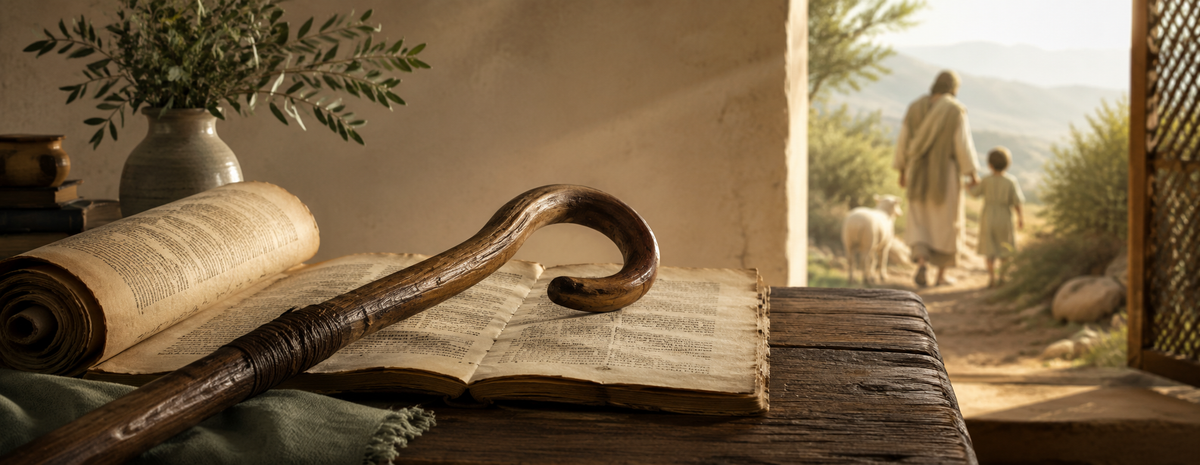
Shebet, however, is not actually a beating stick. It's the shepherd's staff and the same word used in Psalm 23 "Your rod and your staff, they comfort me."
The rod is listed as a source of comfort - not pain and punishment. Nobody is being beaten in Psalm 23, not even a little child. The shepherd carries the staff to guide the sheep, to steer them back when they wander, to fend off the wolves. He doesn't club the flock with it. A shepherd who beat his sheep would be a terrible shepherd, and everyone in the ancient world would have understood that instantly.
Shebet also meant a scepter - the staff a king holds. A symbol of authority and rule, not a weapon for hitting people. When Proverbs talks about the rod, it's drawing on both pictures: the shepherd who guides, and the authority who is responsible for those in his care.
Hebrew had a perfectly good word for a beating. More than one, actually. If the writer wanted to say “strike,” Hebrew had nakah - to strike, smite, beat, wound or even kill. It is not some vague little word. It is very capable of carrying violence when violence is what is meant.
If the writers of Proverbs had meant "hit your kid with a stick," they could have said so with plain language. They didn't. They used shebet - guidance, direction, 'the steadying hand on the flock'.
There is also the issue of the word translated “child.” Hebrew has multiple words in this whole family - son, child, boy, youth, infant, nursing child, weaned child. The rod passages in Proverbs are not using the Hebrew words for a baby or tiny child. They use words like ben, na’ar and yeled - son, boy, youth, young person. In other words, these verses are not about hitting kids. They are not naturally aimed at children under about twelve. People read “child” in English, picture a small child, then pretend that picture came from the Hebrew. It didn’t.
To help this point land, I can confirm that I am still my mother's child - even in my 40s.
The word for "discipline" doesn't mean what you've been taught it means, either
The other word in that verse that seems to mislead people is "discipline," and in Hebrew it's musar. We hear "discipline" in English and our minds often go straight to punishment - a consequence, something unpleasant done to you.
But musar is broader than punishment. It means instruction, correction, warning, training and formation. It is the shaping of a person through wisdom, not the venting of adult frustration through pain.
Jesus had twelve disciples. He taught them, corrected them, rebuked them and formed them - but He never struck them. When they wanted to call down fire on their enemies, He rebuked them. When one cut off a man’s ear, Jesus healed the ear. That is discipline Jesus way: correction without cruelty, authority without violence. He used His higher-status to uplift everyone, no-one left scared or in pain because of His discipline.
So put the actual words back in and the verse reads less like "beat your children" and more like "a parent who refuses to guide and teach their child is actively harming them". So perhaps it's the parent who hits instead of teaching who needs the spanking? I kid. Kind of. Not really.
Hitting with a rod won't kill anyone
I've found people also love to use Proverbs 23:13-14 to justify hurting a child: “Do not withhold discipline from a child; if you strike him with a rod, he will not die.”
Except people have died from being struck with rods. Obviously. People can die from being beaten with sticks, rods, belts, pipes, boards, hands and all the other objects adults have used while pretending they were doing holy work.
So either Proverbs is not giving a literal medical safety guarantee, or we are forced into the ridiculous idea that God said rod-beatings cannot kill. Clearly, the verse is proverbial.
The point is not, “Hit him; he won’t die.” The point is that correction protects a young person from ruin. Guidance saves, instruction rescues...and a parent who refuses to form, teach and correct leads a child to destruction.
Proverbial language is not the same as literal instruction
Proverbs is ancient Hebrew poetry, written in a culture very far from ours, and reasonable people read the imagery differently.
But if there's one thing I hope people will remember before attempting to understand scripture, it's that it was not written in English. It was not written in the west. It was not written with modern understanding...and it was not all literal.
It is a book of Proverbs. The genre is literally telling you not to read it like a flat command manual.
The phrase that gets thrown around with total certainty, that shuts down conversation and justifies harm to children - isn't even in the book.
People who use the Bible to justify their actions don't misunderstand this verse a little. They misunderstand it completely, in the wrong direction, and claim it as the voice of God.
Why this matters to me
I care about this a huge amount.
Why? Because a misquoted line has been used to put a religious stamp of approval on hurting the smallest, most defenceless people in any household. Kids can't argue back with any real authority. They can't leave or fact-check the adult standing over them. For generations the people doing the hitting got to feel righteous about it, because somebody told them the Bible commanded it.
Where is the fuming, vomit emoji when I need it??
People hit because a child didn't cater to their preferences, because the adult believes they should be treated better than Jesus was treated, because they are afraid of what will happen if they don't hit...
They don't understand that a child's brain under 5 is literally incapable of full-scale impulse control. The lower brain is driving much of their reaction while the rest is still developing. The higher-level control system does not arrive fully formed, yet small children are so often treated as though they should be able to do something God never designed them to do yet.
"They must obey".
Oh really?
I've hardly experienced that from God. He teaches me. He allows me to fall and experience Him pulling me back up. He warns me not to do certain things. He removes me, or others, from certain situations at times. But He has never once struck me. Not when I lied. Not when I cheated. Not even when I cussed Him out and called Him evil.
When actually considering what shebet means - the staff that guides, the staff that comforts, the staff that pulls a wandering creature gently back toward safety - there emerges a beautiful picture of authority that looks like protection, not pain. It looks like the face of The Father.
The whole point of those verses is about providing safety for the vulnerable, not breaking them.
The God who protects His children is a God worth taking seriously.
The version that paints him as violent and cruel - that is the one we should be warning our kids to avoid.